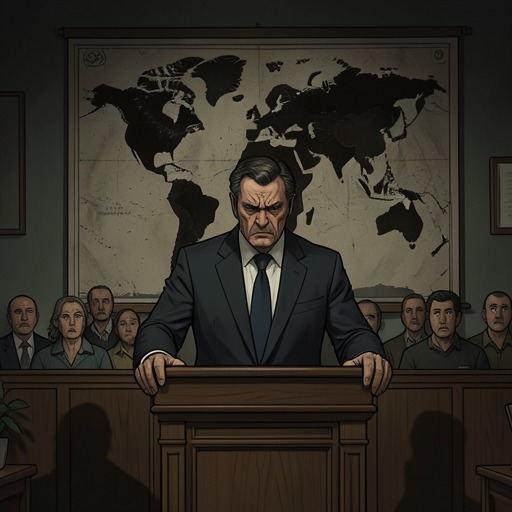
2017 Campus Apocalyptic Crisis Lecture
What Are You Going ThroughThe 2017 Campus Apocalyptic Crisis Lecture is a public address in which a prominent author argues that human civilization is approaching catastrophe and has failed to muster the will to prevent it. Delivered in September 2017 to a half-full college auditorium, the talk moves from a catalogue of manufactured dangers to the question of how people should live when a future of suffering seems unavoidable. Its final appeal is not to confidence in rescue but to moral attention, atonement, and learning how to say goodbye.
Setting and Occasion
The lecture takes place in the third week of September 2017 at a college campus. Its speaker is a professor at a school in another part of the country and a well-known author who had won an international prize earlier that year. The event is free and open to the public, but the auditorium is only half full. The narrator is there by coincidence: a dear old friend is being treated at a local hospital specializing in her type of cancer, and the narrator has come to visit her despite the possibility that, given the seriousness of the illness, they may not meet again.
The talk is based on a long magazine article the narrator has already read, as have the narrator’s friend and, the narrator suspects, many people in the audience. Some attendees appear to have come hoping to discuss its arguments. The speaker, however, has decided not to take questions; the audience learns this only after he has finished. That withheld information shapes the event’s reception: listeners hear a forceful statement of crisis without the discussion they may have expected.
The narrator arrives already exhausted by an afternoon at the hospital, where watching the friend suffer has demanded an effort to conceal dismay. The lecture is therefore heard under the pressure of a personal encounter with illness, even as its subject expands from individual mortality to the threatened future of human and animal life. The speaker’s address does not provide a refuge from that pressure. It enlarges its scale.
The Case for Catastrophe
The speaker presents catastrophe as the consequence of human choices and failures, not as an unforeseeable accident. Nuclear weapons capable of killing humanity repeatedly have been created and left in the hands of leaders portrayed as egomaniacal, nihilistic, and without conscience. The failure to control weapons of mass destruction, together with the failure to keep power from people who might use them, makes apocalyptic war increasingly likely. Even if the nuclear arsenal somehow disappeared overnight, the speaker argues, generations of shortsightedness and self-deception would still have left grave dangers in place.
Ecological destruction is central to this indictment. Fossil-fuel industrialists and their political allies have profited enormously while working to deny climate change, and the public has failed to stop them. The speaker imagines food and water shortages driving refugees into desperate flight, only for them to encounter indifference or cruelty. Nor would the extinction of humanity leave other species free to flourish: animals, including those not already destroyed by human activity, would be caught in the same catastrophe. The talk’s slight break in composure comes when the speaker discusses animals, with a small catch in his throat; for human beings, the narrator perceives no comparable display of pity.
The inventory broadens beyond nuclear and ecological risk. Cyberterrorism, bioterrorism, an anticipated flu pandemic for which society is unprepared, drug-resistant infections caused by indiscriminate antibiotic use, far-right political movements, propaganda, deceit, and the inability to defeat global jihadism all appear as threats to life and liberty. The speaker also condemns the concentration of power in technology corporations and the mass surveillance on which their influence depends. He warns that tools presented as ordinary features of modern life could enable ruthless control, while people seem helpless before the companies that supply them. These dangers are linked by a recurring question of responsibility: how did a supposedly free society permit powerful institutions and actors to acquire such reach?
From Diagnosis to Moral Demand
The speaker rejects the idea that greater awareness or individual composure will be enough. Extreme weather and the risk of extinction for a million animal species, he says, have not succeeded in making environmental destruction a leading public concern. He criticizes educated and creative people for turning toward personal therapies, pseudo-religious detachment, mindfulness, and self-care while neglecting collective danger. Inner equanimity may help an individual face disaster, but, in his analogy, it cannot right the Titanic. What the crisis requires, he argues, is not retreat into private calm but an overwhelming collective preoccupation with the threat.
His question of how people should live leads to the talk’s most disruptive proposal: society should reconsider whether people ought to go on having children. He is not, as he clarifies, telling every pregnant woman to have an abortion. Rather, he asks whether it is mistaken, selfish, or cruel to plan families as though the world were unlikely to become bleak or unlivable within a child’s lifetime. He sets that possibility beside the needs of children already alive and people enduring humanitarian crises, asking why attention is not directed toward those who are already suffering. This passage is new relative to the magazine article and unsettles the audience: listeners murmur and shift in their seats, and a woman laughs nervously.
The address ends with a call for a final chance at redemption. A civilization facing its own end should learn to ask forgiveness and make some measure of atonement for the harm it has done to humanity, other creatures, and the earth. The speaker calls for people to love and forgive one another as best they can, and to learn how to say goodbye. The ending does not undo his insistence that suffering lies ahead; it gives the audience an ethical task within that bleak forecast rather than a promise that the forecast can be reversed.
Delivery and Reception
The narrator describes the speaker as a highly accomplished performer. He occasionally looks down at an iPad on the lectern but speaks with the fluency of someone who has memorized the address, never stumbling or hesitating. His measured, controlled delivery makes the dire claims sound less like speculation than settled fact. The narrator finds a disjunction between this calm cadence and the terrible content: the speaker appears almost without emotion, apart from the brief catch in his throat when he speaks of animals. At moments he looks across the room with a raptor-like gaze.
After the final appeal, the speaker takes his iPad and walks quickly backstage. The clapping is uneven enough to register the audience’s confusion about whether he will return. Instead, the woman who introduced him comes back to the podium, thanks the audience, and wishes them good night. People leave in a subdued mood. Some are silent or dazed; others complain that the speaker refused questions, speculate that he was annoyed by the half-full room, or dismiss the talk as boring. The narrator hears one attendee say that coming had been someone else’s idea. The varied responses show the distance between the scale of the speaker’s warning and the ordinary social habits with which the audience tries to absorb it.
In a later exchange about his manner and his continued public speaking, the speaker acknowledges hostility toward people he believes have failed to act, including privileged, well-educated Americans who elected a climate-change denier and oil executives who concealed research on fossil fuels and global warming. He says that he has lost faith in people doing the right thing, but also explains why he keeps speaking: he wants to be able to face his grandchildren when they ask what he did. He connects that effort to anger and guilt, and to the conviction that he wasted time on concerns that now seem trivial. This later explanation makes the lecture’s severity more complicated. Its speaker does not claim to speak from hope; he speaks, despite despair, so that the truth and the question of responsibility cannot be dismissed without being heard.